
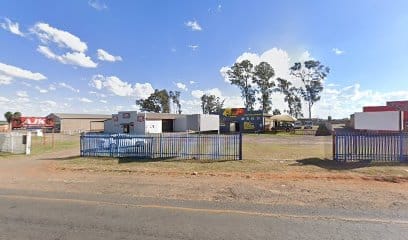
FFMS Steel is a Manufacturer establishment in Vanderbijlpark, Gauteng, South Africa
Vanderbijlpark
Gauteng
South Africa
Sorry, no records were found. Please adjust your search criteria and try again.
Sorry, unable to load the Maps API.
Manufacturer Services in Vanderbijlpark, Gauteng
In Vanderbijlpark, Gauteng, manufacturers offer a broad spectrum of services aimed at turning technical concepts into tangible products. The industrial localisation of the area supports a range of activities from turnkey projects to specialised subcontracting, with capabilities that typically cover metalworking, fabrication, assembly, and finishing. Clients usually engage local manufacturers for components, assemblies, and customised solutions that require close collaboration and practical on-site or off-site production capability.
Core services commonly encountered include metal fabrication and machining. This encompasses cutting, bending, welding, and assembly of metal structures, as well as precision machining through tool and die work, milling, turning, and drilling. Many operations also provide surface finishing services such as galvanising, painting, powder coating, and protective coatings to extend product life in demanding environments. Where required, electrical and mechanical integration is offered, including simple control systems, motors, and cable gland management, enabling a cohesive final product.
Depending on the scope, clients may access prototyping and small-batch production. This allows for iterative design refinement before committing to high-volume manufacture. Prototyping often involves test assemblies, fit checks, and functional verification to ensure that the finished item meets specified tolerances and performance criteria.
Assembly and equipment integration are typical strengths for manufacturers in this region. Turnkey assemblers may combine machined components, fasteners, hoses, fittings, electrical components, and control panels into working units. For customers planning upgrades or retrofits, some providers offer modification services to existing equipment, ensuring compatibility with new processes and improved efficiency.
Quality assurance is a fundamental consideration throughout the manufacturing process. Industry-standard checks—such as dimensional inspection, material verification, and process qualification—are commonly integrated into production workflows. Documentation may encompass job sheets, material certificates, and production records, aligned with customer specifications and applicable regulatory expectations. While specific accreditation details vary, a responsible contractor is typically able to outline quality controls and traceability procedures during initial discussions.
Practical considerations influence how services are delivered. Lead times depend on capacity, current workload, and the complexity of the order. Clients should consider planning around milestones, storage space, and transportation logistics, especially for large or heavy components. Local manufacturers often provide assistance with logistics planning, including secure packing, loading, and delivery or collection arrangements. Availability of on-site assessments or factory visits can help gauge capability, safety standards, and site compatibility before a project begins.
Health and safety form a central part of operations. Suppliers typically operate in line with prescribed safety protocols, site access controls, and risk assessments. Environmental considerations, such as waste management and energy efficiency, are increasingly integral to day-to-day practices, particularly for larger or continuous processes. Prospective clients are advised to discuss compliance expectations and any site-specific requirements early in the negotiation stage.
Communication generally follows a structured workflow: initial enquiry, specification clarification, rough budgeting or quotation, design alignment if needed, production scheduling, and regular progress updates. Depending on the project, customers may receive previews of work-in-progress, samples for initial approval, and staged delivery to optimise cash flow and inventory management. While the exact format may differ between providers, the underlying principle remains clear: collaboration to deliver fit-for-purpose outcomes within practical constraints of time, cost, and quality.
Overall, the Vendorpark–Vanderbijlpark manufacturing sector provides practical, hands-on services that support local industry needs—from metered, precise fabrication to complete assemblies and adaptable production options. Clients anticipate a service that is responsive to their specifications, mindful of safety and environmental considerations, and capable of translating technical drawings into reliable, ready-to-use components and systems.